

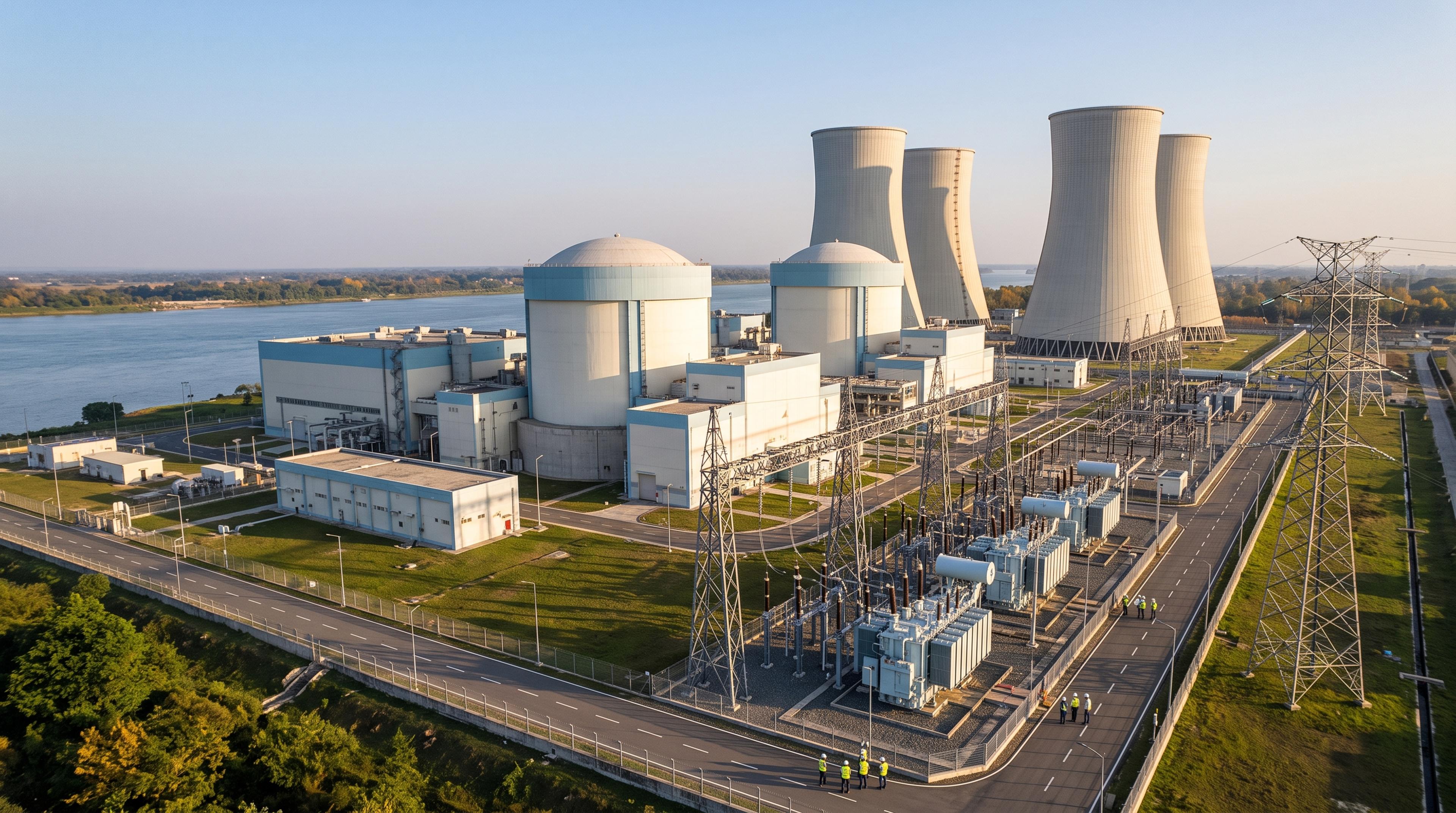
At 12:20 p.m. on Saturday, October 3, a heavily guarded convoy of military, police, and intelligence vehicles rolled through the gates of the Rooppur Nuclear Power Plant in Ishwardi, Pabna, delivering a fresh consignment of Russian uranium fuel that puts Bangladesh’s first atomic energy facility within reach of generating electricity this winter.
The special cargo flight carrying the nuclear fuel assemblies had touched down at Hazrat Shahjalal International Airport in Dhaka late Friday night at 11:45 p.m. before making the highway journey northwest to the banks of the Padma River. Speaking after the shipment was formally received by Project Director Kabir Hossain and Nuclear Power Plant Company Bangladesh Limited (NPCBL) Managing Director Zayedul Hasan, Science and Technology Minister Fakir Mahbub Anam confirmed that the remaining uranium shipments are expected within the next seven to 10 days, putting the plant on track to feed its first power into the national grid between December 2026 and January 2027.
For a country that spent the summer of 2026 grappling with $24-per-MMBtu spot natural gas prices, furnace oil hikes, and persistent gas shortages across industrial zones, the final countdown at Rooppur is more than a symbolic engineering feat. Once both of its 1,200-megawatt (MW) reactors reach full operation, the $12.65 billion facility is designed to supply roughly 10 percent of Bangladesh’s electricity capacity with near-zero carbon emissions. Getting those electrons onto the grid, however, requires navigating high-pressure reactor physics, tangled South Asian airspace politics, and tightening Western financial sanctions on Moscow.
Inside the VVER-1200 Commissioning Sequence
Delivering uranium canisters to the plant site is only one part of bringing a nuclear reactor to life. Before a nuclear station can split atoms to boil water and spin steam turbines, engineers must prove that its cooling loops and safety valves can withstand extreme heat and pressure without a single leak.
Rooppur utilizes two Russian-designed VVER-1200 reactors, a Generation III+ pressurized water reactor (PWR) model built by Russia’s state nuclear corporation, Rosatom. In a pressurized water reactor, water inside the primary circuit is kept under immense pressure so that it can absorb heat from the uranium fuel core up to roughly 300°C without boiling into steam inside the reactor vessel itself. Instead, that superheated water passes through steam generators to boil a separate, isolated secondary loop of water that drives the turbine generators.
Comments
0Join the discussion
You must be logged in to leave a comment.